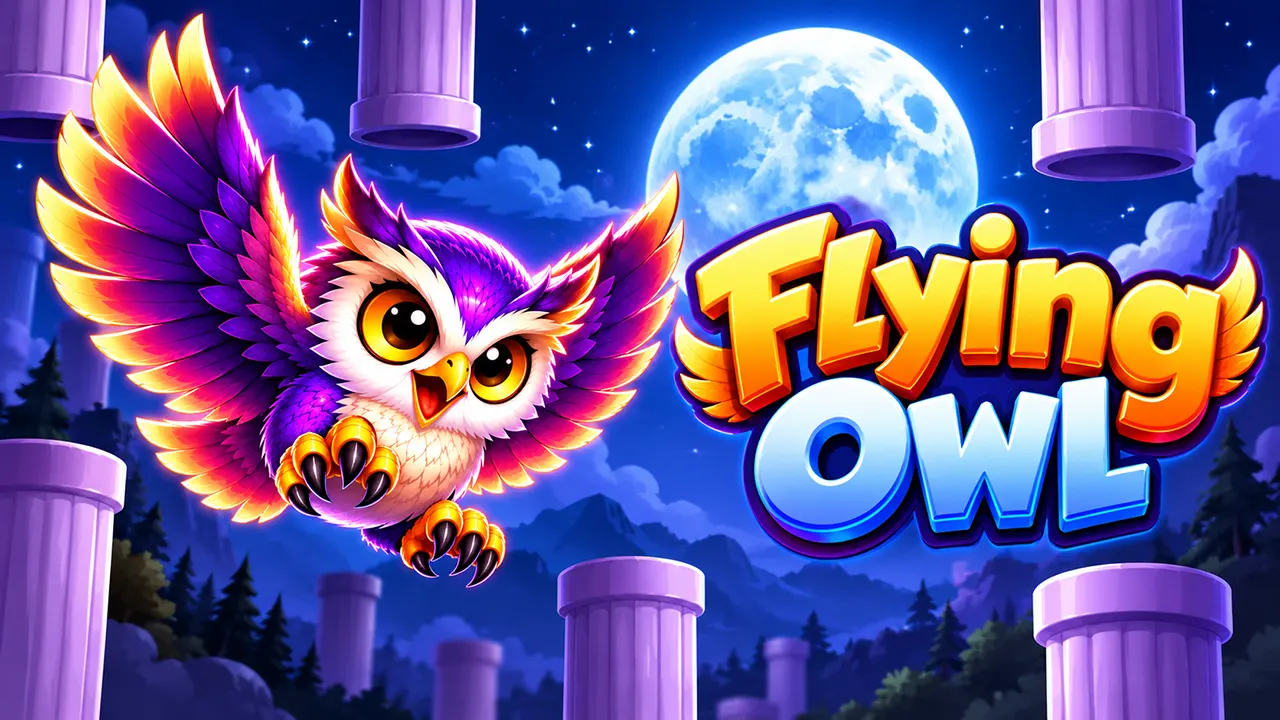
Flying Owl – Soar Through a Colorful Moonlit Sky Flying Owl is an exciting endless flying game where you take control of a fearless owl and guide it through a beautiful night sky filled with challenging obstacles. Keep your owl in the air, fly carefully between pipes, collect points, and survive for as long as possible while trying to achieve your highest score. The idea is simple: keep flying without hitting the pipes. That simple objective quickly becomes a test of timing, concentration, and precise control. Every movement affects the owl's flight, so you need to decide exactly when to rise and when to let the owl move downward. A small timing mistake can put you directly in the path of the next pipe, while a well-timed adjustment can carry you safely through another difficult opening. The colorful moonlit environment creates a calm nighttime atmosphere, but the gameplay demands your...
Flying Owl – Soar Through a Colorful Moonlit Sky
Flying Owl is an exciting endless flying game where you take control of a fearless owl and guide it through a beautiful night sky filled with challenging obstacles. Keep your owl in the air, fly carefully between pipes, collect points, and survive for as long as possible while trying to achieve your highest score.
The idea is simple: keep flying without hitting the pipes.
That simple objective quickly becomes a test of timing, concentration, and precise control. Every movement affects the owl's flight, so you need to decide exactly when to rise and when to let the owl move downward. A small timing mistake can put you directly in the path of the next pipe, while a well-timed adjustment can carry you safely through another difficult opening.
The colorful moonlit environment creates a calm nighttime atmosphere, but the gameplay demands your full attention. As your run continues, every successful obstacle adds to the challenge of maintaining your concentration.
How far can your fearless owl fly before the night sky finally becomes too difficult?
Take Flight Into the Night
Your journey begins beneath a colorful moonlit sky.
The owl is ready to fly, but the path ahead is filled with obstacles.
Your task is to guide it safely through each opening without allowing it to collide with the pipes.
You do not need to follow a complicated set of objectives.
Fly.
Avoid the pipes.
Collect points.
Keep going.
The challenge comes from doing these simple things consistently.
The farther you travel, the longer you need to maintain accurate control without making a mistake.
One successful opening leads directly to another, turning every run into an ongoing test of your flying skills.
Control the Flying Owl
Learning how to control the owl is the first step toward a strong run.
The controls are smooth and straightforward, but accurate movement still requires practice.
Pay attention to how your input affects the owl's height.
You need enough upward movement to avoid dropping too low, but climbing unnecessarily high can be equally dangerous.
The goal is not to constantly force the owl upward.
Instead, make controlled adjustments that keep it lined up with the next safe opening.
Once you understand the owl's movement, you can start focusing farther ahead and preparing for upcoming pipes.
Avoid the Pipes
Pipes create the main obstacle throughout your flight.
Each set leaves an opening that your owl needs to pass through safely.
The challenge is positioning the owl at the correct height before reaching that opening.
Do not wait until the pipe is directly in front of you.
Look ahead.
Identify where the gap is located and begin preparing your flight path early.
If the opening is higher than your current position, adjust accordingly.
If it is lower, avoid unnecessary upward movement and allow yourself enough room to descend.
Early preparation makes difficult gaps much easier to handle.
Aim for the Open Space
A useful way to approach each obstacle is to stop thinking about the pipes themselves and focus on the empty space between them.
That opening is your target.
Guide the owl toward it.
This can make your movement feel more deliberate.
Instead of thinking, "Don't hit the pipe," think, "Fly through the center of that gap."
Focusing on the safe route can help you avoid overcorrecting because your attention is directed toward where you want the owl to go rather than toward the obstacle you are trying to avoid.
Timing Is the Heart of Flying Owl
Good timing determines how successfully you move through the night sky.
An input made too early can leave the owl too high when it reaches the pipe.
Reacting too late may not give you enough time to reach the opening.
Try to understand the relationship between your input and the owl's movement.
During your first attempts, you may make many corrections.
That is normal.
As you become familiar with the controls, you can begin making movements earlier and more accurately.
Eventually, good timing starts to feel natural.
Don't Overcorrect
One of the easiest mistakes is making too many movements when only a small adjustment is needed.
Imagine that the owl is already close to the correct height.
A large upward correction may carry it past the safe area and toward the upper pipe.
Instead, use controlled movement.
Small corrections are often easier to manage.
The more accurately you can control the owl's height, the less often you will need desperate last-second adjustments.
Smooth flying comes from making the right movement rather than making the most movement.
Watch the Next Gap
After successfully passing one pipe, immediately look for the next opening.
Do not spend too much time celebrating the obstacle you just cleared.
The next challenge is already ahead.
Try to identify whether the next gap is higher, lower, or close to your current flight path.
This gives you valuable preparation time.
Players who constantly look ahead can begin adjusting gradually instead of waiting until the final moment.
Find Your Flying Rhythm
Flying Owl has a natural rhythm.
Adjust the owl.
Approach the opening.
Pass through.
Locate the next gap.
Adjust again.
Once you become comfortable with this pattern, the game can begin to feel smooth and flowing.
Do not confuse rhythm with repeating exactly the same movement every time.
Each opening may require a different approach.
The rhythm comes from your process of observing, preparing, and responding.
Stay Near a Useful Height
When possible, avoid placing your owl at an extreme height without a reason.
Being very high can make a lower opening harder to reach.
Flying extremely low can make a sudden climb more difficult.
Try to maintain a controllable position between obstacles.
This gives you more flexibility when the next pipe appears.
You cannot always remain in the same area because the openings change, but good positioning after one obstacle can make the next one easier.
Collect Points as You Fly
Every successful part of your flight contributes to the challenge of building a better score.
The farther you travel, the greater your opportunity to collect points.
Do not allow the score to distract you from flying.
Your immediate objective should always be the next safe gap.
If you continue passing obstacles successfully, your score can continue increasing.
This makes survival and scoring closely connected.
Better control leads to longer runs, and longer runs create better opportunities for higher scores.
Chase Your Personal Best
Once you establish a score, you have a new target.
Try to beat it.
Your personal best gives every new attempt a purpose.
Perhaps your previous run ended because you climbed too high.
Maybe you reacted too late to a lower opening.
Perhaps you became distracted after realizing that you were close to a new record.
Remember what happened and use that knowledge during the next run.
Beating your best score does not always require dramatic improvement.
Sometimes one fewer mistake is enough.
Don't Stare at the Score
A strong run can become much harder when you begin constantly checking your score.
You realize that you are close to your record.
Suddenly every movement feels more important.
That pressure can disrupt your timing.
Keep watching the flight path instead.
The score is a result of successful flying.
If you continue avoiding pipes, the points will continue taking care of themselves.
Concentrate on the next opening rather than the number.
Learn From Every Collision
Hitting a pipe ends the run, but it can also show you what needs improvement.
Think about the final few seconds.
Were you too high?
Were you too low?
Did you notice the gap too late?
Did you make a large correction when a smaller one would have worked?
Were you looking at the score instead of the next pipe?
Understanding why you collided can help you avoid repeating the same mistake.
Every unsuccessful run can therefore contribute to a better future attempt.
Improve Your Reactions
Fast reactions become useful when the openings require quick changes in height.
Reaction speed improves naturally through practice.
When you first begin, you may need time to understand whether you should rise or descend.
After many attempts, you can recognize the required movement almost immediately.
That familiarity makes the game feel smoother.
You are no longer trying to understand the basic controls during every obstacle. Instead, you are using those controls instinctively.
Precision Matters More Than Speed
Flying Owl is fast-paced, but your objective is not simply to make the fastest possible movements.
Precision is more important.
A quick movement in the wrong direction is not useful.
A controlled adjustment at the correct moment can be much more effective.
As you practice, your accurate movements can naturally become faster.
That is the ideal improvement: better reactions without sacrificing control.
Keep Your Eyes Ahead
Looking ahead is one of the most useful habits you can develop.
Do not stare directly at the owl throughout the entire run.
You already know where it is.
Use some of your attention to observe the upcoming pipe and its opening.
This gives your brain more time to prepare the next movement.
When you know what is coming, you can position the owl gradually.
When you react only after the obstacle becomes immediate, every movement becomes more stressful.
Prepare Before the Opening
Try to have the owl close to the correct height before it reaches the pipe.
Do not rely on a dramatic last-second correction.
The earlier you line up with the opening, the easier it becomes to pass through safely.
This does not mean you should completely commit to the gap too early.
Continue making small adjustments as necessary.
The goal is to approach the obstacle in a controlled position that requires only minor correction.
Stay Calm After a Close Call
Sometimes your owl may pass extremely close to a pipe.
Surviving such a moment can be exciting.
Do not let that excitement distract you.
The next pipe is already approaching.
Immediately return your attention to the flight.
A close escape does not matter if you collide with the next obstacle because you were still thinking about it.
Recover your rhythm and continue.
Long Flights Test Concentration
Short attempts mostly test your ability to understand the controls.
Long flights test something else: concentration.
After successfully passing many obstacles, it is easy to become comfortable.
You may begin making careless movements.
You may start watching your score.
You might assume that the next gap will be easy.
This is when mistakes often happen.
Treat every new pipe seriously regardless of how long you have already survived.
Don't Panic When the Gap Changes Height
One opening may be high and the next may be low.
That sudden change can make players react too aggressively.
Stay calm.
Look at how much height you actually need to change.
Then make controlled adjustments.
The gap does not need to be reached instantly.
You only need to be correctly positioned when the owl arrives at it.
Using the available distance to gradually adjust can make large height changes easier to handle.
Smooth Flying Creates Better Runs
A strong run often looks controlled rather than chaotic.
The owl rises when necessary.
It descends when appropriate.
Corrections are purposeful.
The player is already thinking about the next opening.
Try to develop this smooth style.
Avoid constantly fighting against your own previous movement.
When your flight becomes more controlled, you have more attention available for reading the obstacles ahead.
Endless Gameplay Means Every Run Is a New Challenge
Flying Owl is built around endless gameplay.
There is always another obstacle ahead as long as you continue surviving.
This makes the goal different from simply reaching a finish line.
Your challenge is to see how far your skills can take you.
Every pipe you pass extends the run.
Every point makes your current attempt stronger.
Eventually, the question becomes whether you can maintain your concentration longer than you did during your previous best attempt.
Set Small Goals
If your high score feels difficult to beat, create smaller targets.
Try to pass several obstacles without making a large correction.
Focus on keeping your movement smooth.
Practice preparing for gaps earlier.
Try not to look at the score during the run.
Work on recovering quickly after a close call.
Improving these smaller skills can eventually produce the larger result you want.
Build Consistency
A personal record is exciting, but consistent performance is also important.
If one attempt goes extremely well but most runs end quickly, there is still room to improve.
Try to make your average run stronger.
Reduce simple mistakes.
Recognize openings sooner.
Improve your timing.
Use fewer unnecessary movements.
As your consistency improves, high-score attempts become more common rather than depending on one unusually successful run.
The Moonlit World
Flying Owl takes place against a colorful nighttime setting that gives the game its own visual identity.
The moonlit sky creates a fitting environment for your fearless flying owl.
The bright, colorful presentation contrasts with the challenge of navigating through the pipes.
Enjoy the scenery, but keep your attention on the flight path.
The world may look peaceful, but every upcoming obstacle requires concentration.
A Fearless Owl Against an Endless Sky
The owl is constantly moving forward into another challenge.
There is no finish line waiting just beyond the next pipe.
Instead, every successful obstacle asks the same question again:
Can you pass one more?
That simple idea creates the game's replay challenge.
A failed run encourages another attempt because you already know that reaching your previous score is possible.
The real challenge is going beyond it.
Simple Controls, Real Challenge
Flying Owl does not need complicated controls to create difficult gameplay.
The basic flying system is straightforward.
The challenge comes from using it accurately.
You need to control height, recognize openings, react to changing positions, and maintain your concentration.
Simple controls make the game easy to understand.
Precise timing makes it difficult to master.
This balance allows new players to begin quickly while giving experienced players a reason to continue improving.
Flying Owl Tips for a Higher Score
Focus on the gaps rather than staring at the pipes.
Look ahead instead of watching only the owl.
Begin adjusting before the obstacle reaches you.
Avoid unnecessarily large movements.
Try to keep the owl at a controllable height between pipes.
Do not panic when consecutive openings are at very different heights.
After passing a pipe, immediately identify the next gap.
Ignore your score during difficult sections.
Stay calm after close calls.
Learn from every collision.
Practice smooth movement instead of random corrections.
Keep concentrating even when you have already achieved a strong run.
Most importantly, focus on surviving the next obstacle rather than worrying about your final score.
Easy to Learn, Difficult to Master
The rules of Flying Owl can be explained in seconds:
Keep the owl flying.
Avoid the pipes.
Pass through the gaps.
Collect points.
Stay alive.
Beat your high score.
Anyone can understand the objective.
Mastering the game requires much more.
You need consistent timing rather than one lucky movement.
You need concentration over an entire run.
You need to recognize openings quickly and adjust the owl without overcorrecting.
That difference between simple rules and demanding execution creates the challenge.
Challenge Your Reflexes
Each obstacle tests how quickly you can process what you see.
You notice the gap.
You compare it with your current height.
You decide whether to rise or descend.
Then you make the movement.
With practice, this sequence becomes faster.
Eventually, you may perform it almost automatically.
That improvement is one of the most satisfying parts of score-based arcade gameplay.
How to Improve Your High Score
If you want to achieve a better score, do not focus exclusively on the number.
Improve the skills that create the score.
Work on your timing.
Improve your ability to judge height.
Look farther ahead.
Reduce unnecessary corrections.
Stay calm during difficult transitions.
Maintain concentration for longer.
As these individual skills improve, better scores can follow naturally.
A record is the result of good flying, not something you can force simply by watching the scoreboard.
Why Play Flying Owl?
Flying Owl combines a colorful nighttime world with straightforward endless arcade gameplay.
You control a fearless flying owl.
You navigate through pipes.
You search for safe gaps.
You collect points.
You test your reactions.
You improve your timing.
And you challenge your own high score.
The basic concept is immediately understandable, making it easy to begin another run.
At the same time, consistently navigating the obstacles provides enough challenge to reward practice.
If you enjoy endless games built around timing, precision, reactions, and high-score chasing, Flying Owl provides exactly that kind of challenge.
Frequently Asked Questions
What is Flying Owl?
Flying Owl is an endless flying arcade game where you guide an owl through a colorful moonlit environment while avoiding pipes and collecting points.
What is the objective of Flying Owl?
Your goal is to keep the owl flying, pass safely through the pipe openings, collect points, and achieve the highest score possible.
What obstacles do I need to avoid?
The primary obstacles are pipes that create openings your owl needs to fly through safely.
How do I get a higher score?
Keep the owl alive for longer, successfully navigate more obstacles, and maintain accurate control throughout your run.
Why is timing important?
Your timing determines the owl's height as it approaches each opening. Moving too early or too late can lead to a collision.
Should I focus on the pipes or the gaps?
Focusing on the safe opening can make it easier to guide the owl toward the correct position.
How can I improve my flying?
Practice making controlled movements, look ahead to the next gap, avoid overcorrecting, and learn from the mistakes that end each run.
What should I do after passing a pipe?
Immediately look for the next opening and begin preparing your position.
What should I do when I am close to my high score?
Continue concentrating on the obstacles rather than watching the score. Maintain the same controlled approach that brought you that far.
Is Flying Owl an endless game?
Yes. The gameplay is based on continuing through obstacles and surviving for as long as possible while increasing your score.
Is Flying Owl easy to learn?
The controls and objective are simple to understand, but consistently navigating the pipes requires timing, precision, and practice.
What makes Flying Owl challenging?
The challenge comes from maintaining the correct height, reacting to changing gaps, avoiding pipes, and keeping your concentration throughout a long run.
How Far Can Your Owl Fly?
The moon is shining, the night sky is waiting, and another endless flight is ready to begin.
Take control of your fearless owl and concentrate on the path ahead.
Watch the pipes.
Find the openings.
Adjust your height.
Fly through each gap and immediately prepare for the next one.
Your first goal is simply to survive. Once you become comfortable with the flying controls, start challenging your previous scores. Try to make your movements smoother and your reactions faster. Learn to recognize the next safe opening earlier and avoid unnecessary corrections.
Every pipe you pass takes you farther into the moonlit world.
Every successful movement keeps the run alive.
Every point brings you closer to a new personal record.
There is always another gap ahead and another opportunity to prove that your timing is improving.
Spread your wings, fly through the colorful night sky, avoid the pipes, collect the points, and see how high you can score with your fearless Flying Owl!














Comments
0